Rheumatology
Rheumatology at Tel Aviv Medical Center
Rheumatology at Tel Aviv Medical Center deals with diseases of the joints, soft tissue and connective tissue, and with autoimmune diseases. You can book ahead to see a senior rheumatologist on the team, such as Dr. Gil Bornstein, for the full range of diagnostic assessments and treatments in this broad and complex field of medicine.
At Tel Aviv Medical Center you can also have various diagnostic tests, including blood tests and urine tests, and imaging tests such as an MRI scan or ultrasound. These tests help in planning the best and most appropriate treatment for each rheumatological condition.
You can book an appointment with the Rheumatology department at Tel Aviv Medical Center with full or partial coverage for people with private health insurance or suitable supplementary insurance.

Rheumatologist consultation
- 3 steps, less than a minute
- No credit card needed
- Instant SMS confirmation
- You can cancel up to 24 hours before
For patients who have seen this doctor in the last six months
Prefer to book by phone? 03-771-2804
What is rheumatology?
Rheumatology is a field of medicine that focuses on diseases of the joints, connective tissue and soft tissue, and on other autoimmune diseases that can also show up in the joints. Rheumatology is considered a subspecialty of internal medicine, and rheumatologists are usually internists who complete additional specialty training in this field and gain extensive professional experience in it.
Most major rheumatic diseases are autoimmune, meaning that the immune system attacks the body. This requires broad knowledge of these diseases in general and of the treatment of each one in particular. Because these are mainly autoimmune and chronic diseases, rheumatological treatment sometimes focuses on managing the disease rather than only on a permanent cure (which is not always possible), and on allowing the patient to live a healthy, normal life even when diagnosed with a chronic rheumatological disease.
We will describe these diseases in detail below, but first it is important to understand what the rheumatology services at Tel Aviv Medical Center look like.
A rheumatology department that provides complete and thorough care
The Rheumatology department at Tel Aviv Medical Center provides care for all the main rheumatological conditions and diseases. Its team includes leading doctors in the field, among them senior Rheumatologist Dr. Gil Bornstein.
At the scheduled appointment, the rheumatologist will examine the patient thoroughly. Depending on the main complaint, the patient will be referred for relevant tests. The most relevant tests in rheumatology are laboratory tests, meaning urine and blood tests. These tests, together with imaging tests and the doctor's clinical examination, help the doctor build an accurate diagnostic picture, after which the right treatment plan can be put together for each patient. The Rheumatology department at Tel Aviv Medical Center meets all these needs, from the doctor's examination through the diagnostic tests to personalized treatment that takes the patient's needs into account.
The importance of laboratory tests in diagnosing rheumatological diseases
In rheumatological diseases, the most important diagnostic tests will usually be laboratory tests, specifically blood and urine tests. This is because many rheumatological diseases produce characteristic markers in the blood that can be detected in a blood test. This makes it possible to distinguish accurately between diseases that can look and feel similar but whose treatment is significantly different. Examples include blood markers of lupus, such as ANA antibodies, and a rise in uric acid during a gout attack.
Rheumatological diseases treated at Tel Aviv Medical Center
Rheumatology at Tel Aviv Medical Center diagnoses and treats all the main, common and important rheumatological diseases. They are described in detail below:
Rheumatoid arthritis
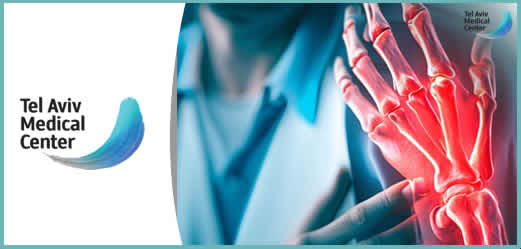
Rheumatoid arthritis (RA) is a disease that mainly affects the joints, but it actually has effects throughout the body, and the more severe it is, the more it impairs the person's overall functioning. People with this disease will have episodes of fever and fatigue, with recurring inflammation in the joints (especially the hands) and other symptoms such as lumps (nodules) that form in different parts of the body, eye inflammation and blood vessel diseases. Women have RA about twice as often as men, and the typical age of onset is 35-50. Diagnosis is based on the doctor's examination and the pattern of inflammation typical of the syndrome, together with typical blood markers (RF, Anti-CP or Anti-CCP) and/or an appearance typical of RA inflammation on an X-ray. Diagnosis depends most of all on clinical findings: an accurate and skilled examination by a doctor will identify RA even if the disease has no clear signs in a blood test or imaging. Treatment of RA is based on a combination of symptomatic treatment for flare-ups and recurring inflammation, and more aggressive treatment intended to reduce the intensity and frequency of the disease flare-ups.
Psoriatic arthritis
Psoriatic arthritis is a chronic form of Arthritis that develops in people already known to have psoriasis (a skin disease), or at the same time as the skin disease first appears. The joint inflammation in this disease can look somewhat similar to that of rheumatoid arthritis, so diagnosing the disease and interpreting the various tests, as well as finding the signs of psoriasis, require a highly skilled Rheumatologist. Treatment of the disease is in most cases based on symptomatic anti-inflammatory treatment (usually with NSAIDs), and in severe cases antirheumatic drugs (DMARDs) will be used, as in rheumatoid arthritis.
Ankylosing spondylitis
Ankylosing spondylitis (AS) is a disease that mainly attacks the joints between the vertebrae of the spine. The disease is more common in young men. It first appears as lower back pain that does not go away, together with stiffness that causes a fixed limitation in the range of motion. The disease affects many body systems. Although it starts in and centers on the vertebrae of the spine, it can show up as eye inflammation and damage to the blood vessels, lungs, digestive system and more. Diagnosis of the disease is based on a doctor's examination, with 3 simple clinical tests that an expert Rheumatologist can perform to diagnose the disease. In addition, the disease can be identified on an MRI scan, and it also has typical genetic markers that can be identified in a genetic test. The most effective treatment for the disease is physiotherapy and symptomatic treatment with anti-inflammatory drugs. In extreme cases, anti-TNF drugs are used. They have a powerful effect but also cause dependence.
Osteoarthritis
OA, Osteoarthritis, or degenerative arthritis, is widely known to the public as "wear and tear" of the cartilage. It is not exactly an inflammatory disease but rather a degenerative disease, and it is the most common of all rheumatic diseases, especially among people past the age of 65, about 80% of whom show evidence of the disease. The disease can appear in one specific joint (for example, the knee), or affect joints throughout the body, especially the larger joints. This disease does not show up in blood tests, but thorough tests are still usually done so as not to miss another disease, and when the laboratory tests show no signs, OA is diagnosed based on the doctor's examination and an X-ray. There is no cure for OA. The usual approach is referral to physiotherapy, along with keeping to a healthy diet and reducing the load on the affected joints. Under such a regimen, significant improvement can be seen even in people with relatively severe OA.
Fibromyalgia
Fibromyalgia is a chronic disease characterized by pain. People with the disease (mainly women) experience recurring attacks of pain at specific points in the body. The pain has no other explanation. Fibromyalgia is a relatively "new" disease. The disease itself is not recent; rather, until recently it was not well understood and doctors did not know how to treat it. Today the situation is different, and Rheumatologists can offer various treatments that stabilize and control fibromyalgia. Here too, a healthy lifestyle and physical activity are recommended as the most effective way to prevent pain. Symptomatic treatment for pain during attacks can also be combined with SNRI anti-anxiety drugs, which have also been found effective in preventing attacks and reducing their severity.
Gout
Gout, also known as podagra, has probably been the best-known rheumatic disease for many years. It is a localized disease that affects specific joints in the body because of a buildup of uric acid deposits in soft tissue and in the joints. Among men, it occurs in about 2.5% of the population. The disease can be caused by increased production of uric acid in the body or by reduced clearance of it from the body (usually because of a magnesium deficiency). At first, the disease can come in attacks that occur as rarely as once every few years. However, as time passes without treatment, the time between attacks gets shorter and the condition can even become permanent, causing significant pain and harming the quality of life of the people who have it. Diagnosis of the disease is based on drawing fluid from the joint and testing it in the laboratory for uric acid deposits, as well as on imaging tests such as CT or ultrasound (US). During attacks, gout is treated with anti-inflammatory drugs and, if needed, steroids. Between attacks, treatment involves keeping to a certain diet (low in protein and alcohol) and taking drugs that lower uric acid levels, chief among them allopurinol.
Lupus
Lupus (also called SLE) is a multisystem autoimmune disease that at first, and in its mildest form, affects the joints, and later can also affect almost every system in the body. The disease mainly affects young women (average age of onset 15-40), with a prevalence of 1 in 1,000. The disease is strongly characterized by the formation of "immune complexes" in the blood, described as deposits of immune system cells. Blood tests can detect these complexes, which are characteristic of lupus. In most cases lupus is autoimmune, but other presentations include lupus triggered by certain medications or drugs, pregnancy-associated lupus and other forms. The best-known symptom of the disease (though not one of the most severe) is the "butterfly" rash on the patient's face, a rash extending from the center of the face across both cheeks. Diagnosis of lupus is based on typical clinical symptoms such as rashes, mouth ulcers, kidney damage and arthritis, together with blood markers such as ANA, Anti-VDRL, Anti-DNA, Anti-SM and more. The most severe damage from the disease is to the kidneys, so monitoring the health of the kidneys is necessary from the moment the disease is diagnosed and for life. Its treatment is based on drugs that reduce its severity and its attacks: steroids, hydroxychloroquine, anti-inflammatory drugs for flare-ups, and other drugs such as cyclosporine or cyclophosphamide, which are used mainly for severe kidney damage.
Myositis
Myositis, or muscle inflammation, is a disease that, as its name suggests, is characterized by inflammation of the muscles. The disease is autoimmune and can have many manifestations, depending on the specific type of inflammation the patient has. One form is polymyositis, inflammation of many muscle groups in different places in the body. Another is dermatomyositis, a combined inflammation of the muscles and the skin. The most common cases are isolated myositis in certain muscles of the body, and because this is an autoimmune disease, treatment here too is based on immunosuppressive drugs.
Autoinflammatory diseases, with a focus on FMF
Autoinflammatory diseases are diseases characterized first and foremost by persistent fever, usually appearing together with other symptoms. The best-known autoinflammatory disease, and certainly the one of greatest relevance in Israel, is familial Mediterranean fever, known as FMF. It is a genetic disease that is particularly characteristic of North African Jews, and it is characterized by a high, persistent fever with other symptoms such as abdominal pain, chest pain and inflammation of the aorta, joint pain, rashes, muscle pain, inflammation of the testicles (usually in children) and/or fertility problems (in women). The drug used to treat FMF is colchicine, which is given regularly to reduce the frequency and intensity of attacks (but does not help at all during an attack).
Behçet's syndrome
Behçet's syndrome is a rheumatological disease that mainly affects the blood vessels, and it is more common around the Mediterranean, especially in Turkey. The main symptom of the disease is ulcers, mainly on the mucous membranes, in the mouth and on the genitals. The disease can also affect the skin. Eye damage is a relatively common complication and can lead to blindness. The disease is the leading cause of blindness in Turkey. Apart from this, the syndrome also sometimes causes arthritis. It is diagnosed with a genetic test for its typical markers, as well as with blood tests, a biopsy of the ulcers and the doctor's assessment of the symptoms. Treatment here too is with colchicine, sometimes combined with steroids and/or immunosuppressive drugs.
Pseudogout
“False gout” is better known by its medical name, pseudogout. It is very similar to the gout described above, but it is caused by a buildup of calcium rather than a buildup of uric acid. Most cases appear with no clear cause or genetic link, and the inflammation can affect one or more joints. Diagnosis is based on a clinical examination by a Rheumatologist in addition to imaging such as X-ray, CT or US. Treatment of the disease will usually be conservative and based on treating the symptoms, and steroids injected directly into the joint will be used only in severe attacks.
Tel Aviv Medical Center: Rheumatology at the highest level
Tel Aviv Medical Center operates a Rheumatology department of the highest standard, specializing in performing all the tests and providing all the relevant treatments in this broad and varied field. If you have joint pain or a known rheumatological disease, you can book an appointment for an examination by a Rheumatologist and for any test you may need through Tel Aviv Medical Center. All of Tel Aviv Medical Center's treatments and tests take place under one roof, which makes treating a rheumatological condition simpler and more convenient than any alternative.